Manage your cookies preferences

Please select which cookies you are willing to store.

Necessary cookies Always enabled

These cookies will provide you a better experience of our website and help us to improve the performance of Greenpeace.org. You will be able to hide the cookies acceptance banner and use the website features better. We will also use these cookies to collect statistical and anonymised data such as how long users stay on a page or which links are clicked.

In addition to the cookies and technologies described above, we also use other services that will help us to enhance your experience on this website. We also may permit certain third party companies (e.g. Facebook, Google) cookies to help us understand more about our users specific behavior, demographic, and interest data. Those cookies help us to understand how visitors interact with our website (e.g. pages visited) in order to improve visitors experience, operation effectiveness of this platform and our communication strategies.

By clicking “Got it!” you agree to our Cookies Policy.

EXERCISE: MULTIPLE AUDIENCES & SHARED VALUES
Often we want to speak to a couple of audience groups. In such cases, we might develop specific narratives for each audience. But say that’s not possible. How do we create a story that can appeal to multiple audiences?

Lakoff makes the following suggestion: Imagine that you’re sitting with representatives of both groups.

Now ask yourself:

  • How would you speak about the issue you’re working on to make it compelling to both groups?
  • What are the shared values(or the shared deep frames) between your audiences?

Tell your story by appealing to the shared values.

Below is a visual of this basic but powerful concept from George Lakoff:
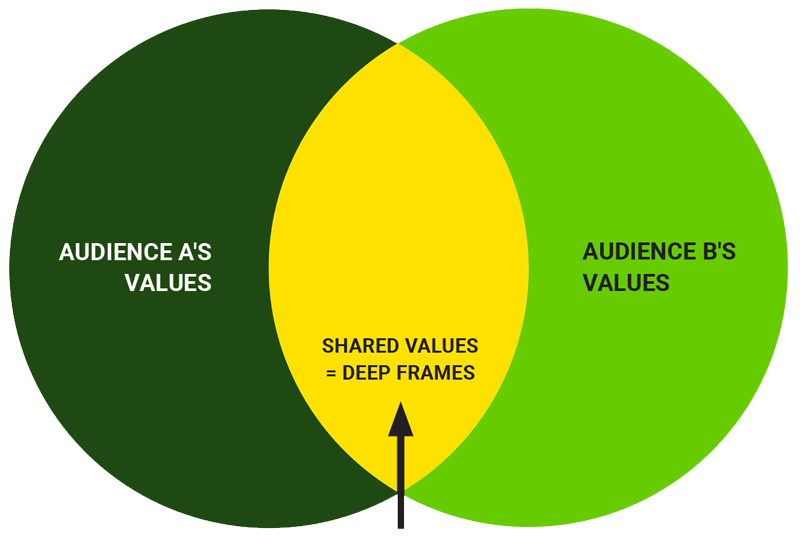
Venn Diagram with 'Audience A's Values' in the left circle; 'Audience B's Values' in the right circle; and 'Shared Values= Deep Frames' in the overlap/middle section.

DOWNLOAD THIS EXERCISE

Thumbnail Image for "Shared Values" Exercise