
Manage your cookies preferences

Please select which cookies you are willing to store.

Necessary cookies Always enabled

These cookies will provide you a better experience of our website and help us to improve the performance of Greenpeace.org. You will be able to hide the cookies acceptance banner and use the website features better. We will also use these cookies to collect statistical and anonymised data such as how long users stay on a page or which links are clicked.

In addition to the cookies and technologies described above, we also use other services that will help us to enhance your experience on this website. We also may permit certain third party companies (e.g. Facebook, Google) cookies to help us understand more about our users specific behavior, demographic, and interest data. Those cookies help us to understand how visitors interact with our website (e.g. pages visited) in order to improve visitors experience, operation effectiveness of this platform and our communication strategies.

By clicking “Got it!” you agree to our Cookies Policy.

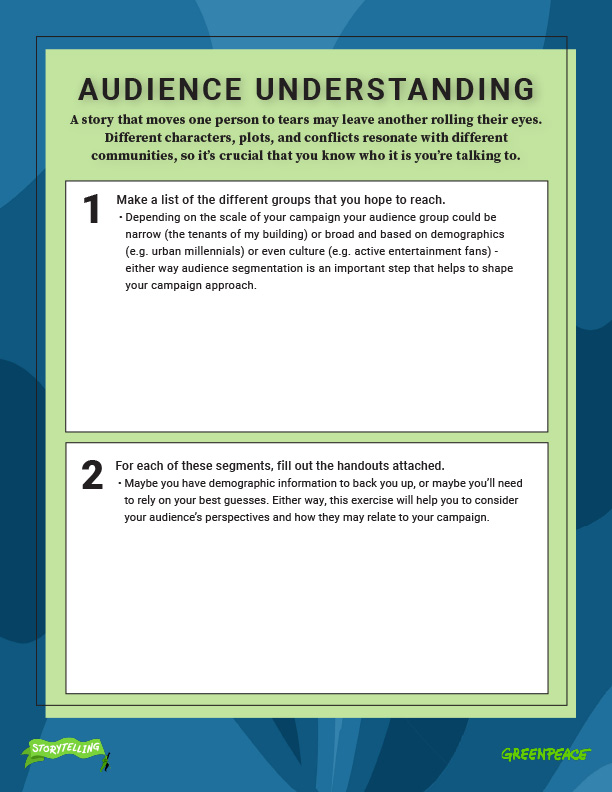
EXERCISE: AUDIENCE UNDERSTANDING

A story that moves one person to tears may leave another rolling their eyes. Different characters, plots, and conflicts resonate with different communities, so it’s crucial that you know who it is you’re talking to.

1

Make a list of the different groups that you hope to reach.

  • Depending on the scale of your campaign your audience group could be narrow (the tenants of my building) or broad and based on demographics (e.g. urban millennials) or even culture (e.g. active entertainment fans) – either way audience segmentation is an important step that helps to shape your campaign approach.

2

For each of these segments, fill out the handouts attached.

  • Maybe you have demographic information to back you up, or maybe you’ll need to rely on your best guesses. Either way, this exercise will help you to consider your audience’s perspectives and how they may relate to your campaign.

DOWNLOAD THIS EXERCISE
Thumbnail Image for "Audience Understanding" Exercise